
Modern Data Stack
A white paper for anyone who wants to modernize their data infrastructure and accelerate data-driven decisions with a modern tech stack, data warehouse and data lake
Download the white paper for freeWithout the Modern Data Stack, the full potential of AI and data-driven innovations remains untapped.
Data is growing rapidly and requirements are increasing, but old systems slow you down. Many companies are faced with the challenge of using big data efficiently and drawing real added value from it for business intelligence and operational decisions. Without the right infrastructure, this quickly becomes an obstacle to growth and innovation.
The modern data stack is the key to a flexible and scalable solution. Our white paper shows you how to build a powerful data architecture with a data warehouse, data lake or data lakehouse and a modern software stack. This is how you make your business smarter, faster and — especially with regard to the use of artificial intelligence — future-proof.
The modern data stack is the key to a flexible and scalable solution. Our white paper shows you how to build a powerful data architecture with a data warehouse, data lake or data lakehouse and a modern software stack. This is how you make your business smarter, faster and — especially with regard to the use of artificial intelligence — future-proof.
Four insights that move your tech stack forward
Find out what makes up a modern tech stack.
Inquire now without obligation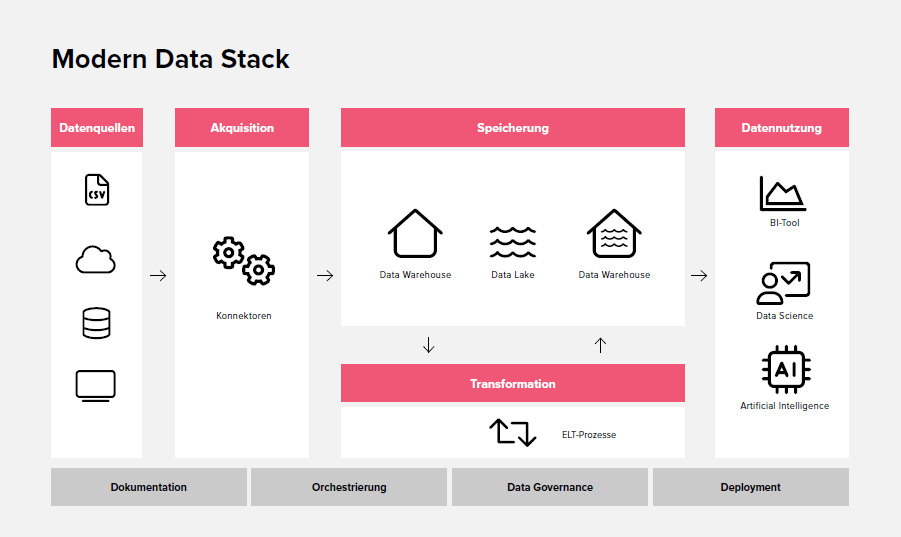
Setup
Where are you standing? Find important answers to the biggest challenges of your tech modernization.
core components
Tasks and development of a modern tech stack from connection to storage and transformation to data usage.
Technologies & tools
Architecture with example setup: Airbyte, Snowflake, dbt and Power BI working together. Plus: Microsoft Fabric out of the box.
AI & Governance
Where is the modern data stack developing? With a practical checklist — so that you are really able to act.
Our technology partners for your modern tech stack


Your data expert and white paper author

The question is no longer whether companies should transform, but when. If you want to use your data efficiently and remain competitive in the future, there is no way around a modern, scalable infrastructure.
Martin Krämer
Project manager, taod
Martin combines business expertise with a clear focus on data strategies and digital transformation. With academic degrees in business administration and business consulting as well as professional experience in project management and data analysis, he has the expertise to help companies develop modern, data-driven solutions. His goal: use data as a strategic tool to achieve measurable success.
Questions that will help you
FAQ
What is a modern data stack and why is it relevant for companies today?
A modern data stack is a modern, mostly cloud-based data architecture that flexibly combines data integration, storage, transformation, analysis, and governance. The aim is to make data available faster, more usable and scalable. This is particularly relevant for companies because data-driven decisions, modern BI applications and AI initiatives are only successful if the underlying data infrastructure is powerful, integrable and future-proof.
What components does a modern data stack consist of in practice?
A modern data stack comprises the entire data journey: the connection of source systems, central storage in a data warehouse, data lake or data lakehouse, the transformation and modelling of the data, and the use in BI, reporting and AI applications. This architecture is complemented by orchestration, documentation, deployment, governance, and data science and AI components. It is not a single tool that is decisive, but the interplay of the components in a consistent architecture.
What advantages does a modern data stack offer compared to traditional data infrastructure?
The key benefits include scalability, flexibility, faster delivery of data, reduced reliance on monolithic systems, and a better basis for self-service analytics. Companies can use computing power and storage as needed, combine specialized tools via interfaces and make data available significantly faster for operational and strategic decisions. At the same time, a modern data stack creates the conditions for productively placing AI applications on a reliable database.
When does a data lakehouse make sense and what role does it play for AI?
A data lakehouse is useful when companies want to use structured and unstructured data in a common architecture. It combines the flexibility of a data lake with the analytical capabilities of a data warehouse. This is particularly relevant for AI applications. As soon as content such as PDFs, documents, websites or knowledge bases are to be processed in addition to classic tables, a lakehouse architecture is often the most sensible way to make this data centrally available and usable for analysis and AI.
What challenges should companies realistically plan for when introducing a modern data stack?
Typical challenges include the integration of distributed data sources, the selection of appropriate technologies, the development of know-how, ensuring data quality and governance, and organizational change. A modern data stack is not just a technical project. It is also changing processes, responsibilities, and collaboration between business, IT and data controllers. A step-by-step approach is therefore usually successful. Start with a clear use case, create benefits quickly and then expand the architecture in a targeted manner.
Learn more about Modern Data Stack

.webp)


Stay up to date with our monthly newsletter. All new white papers, blog articles and information included.
Get exclusive knowledge for your data projects. In our print magazine data! Experienced data experts report directly from the world of data.
Data! subscribe