
Data thinking
A white paper for anyone who wants to systematically develop, prioritize and successfully implement use cases with the data thinking framework
Download the whitepaper for freeData thinking is not a one-off exercise, but a continuous process that combines creativity and strategy.
Data is only as valuable as the ideas it creates. Data thinking is a practical approach to identify, prioritize and implement data-driven use cases in a structured way.
This white paper shows how to use the data thinking framework to combine different perspectives, build a strong use case portfolio and implement projects in a targeted manner — from workshop to rollout. We also highlight the role of a data value creator who ensures that data thinking can be sustainably anchored in the company's data culture. The result is solutions that fit strategically, find acceptance and deliver real business value.
This white paper shows how to use the data thinking framework to combine different perspectives, build a strong use case portfolio and implement projects in a targeted manner — from workshop to rollout. We also highlight the role of a data value creator who ensures that data thinking can be sustainably anchored in the company's data culture. The result is solutions that fit strategically, find acceptance and deliver real business value.
Four perspectives of use case development
How to find suitable use cases for your data project
Inquire now without obligation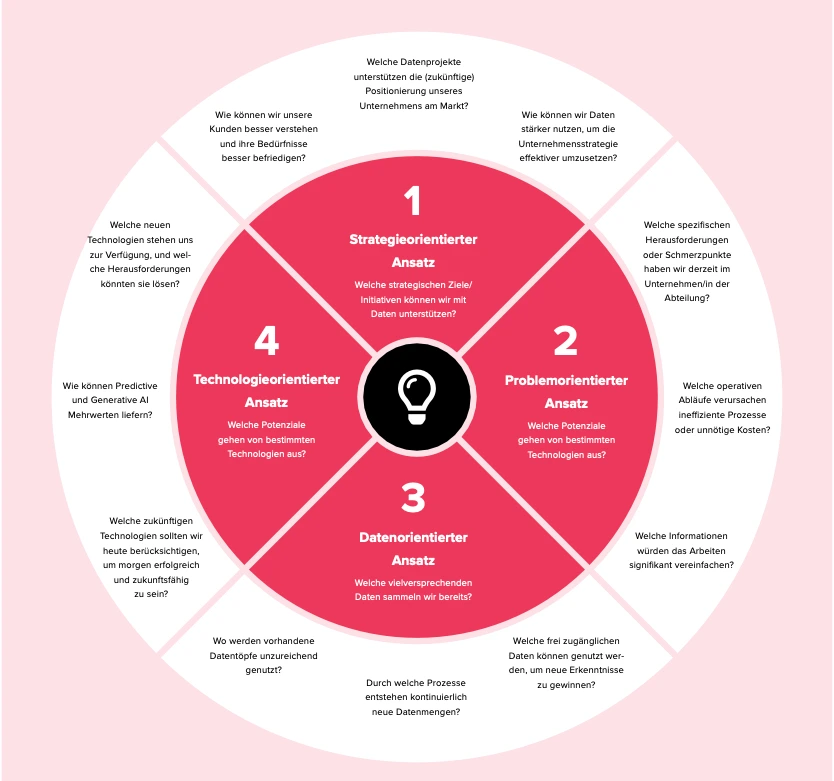
Strategy-oriented approach
Which strategic goals/initiatives can we support with data?
problem-oriented approach
Which pain points or processes cause inefficiencies?
Data-driven approach
What promising data are we already collecting?
Technology-oriented approach
What is the potential of certain technologies?
Your data expert and white paper author
.webp)
In our experience, the first hurdle in exploiting data potential lies in the design phase, namely identifying and prioritizing the right use cases.
Benedikt Köhler
Senior Data Consultant, taod
Data is a driver of success — when used correctly. Ben supports his customers in this: from dashboarding to use case development to strategy definition. He is convinced that by professionalizing its data practice, every company can move forward and become more economically successful. He develops these specific added values in his projects day by day — based on data and with passion!


Questions that will help you
FAQ
How do companies identify the right data-driven use cases?
Successful use cases don't just arise from one perspective. Data thinking combines four perspectives: strategic, problem-oriented, data-oriented and technology-oriented. As a result, long-term business goals as well as acute operational challenges, existing data sources and new technological opportunities can be taken into account. It is precisely this multi-perspective derivation that reduces the risk of overlooking relevant potential or prioritizing technically irrelevant data projects.
How does a data thinking workshop work in practice?
A data thinking workshop typically consists of three phases. In the first phase, as many use case ideas as possible are collected from all four perspectives. In the second phase, these use cases are specified, for example with regard to business goals, processes, data and technologies. In the third phase, use cases are prioritized according to benefits and costs, resulting in a robust portfolio and an actionable roadmap for the next data initiatives.
Should a data team be organized centrally, decentrally or in a hybrid way?
It depends on the level of maturity, resources, and complexity of data work. A decentralized organization has often grown historically, but easily leads to silos and untapped potential. A central data team enables rapid initial success and clear control, but as the number of use cases grows, it is more likely to reach communication limits. A hybrid, federated model combines central standards with more subject-oriented analysts and is therefore often particularly effective when it comes to scaling data work while remaining close to business.
Why is the derivation of use cases so crucial for BI, AI and data projects?
Use cases provide clarity about goals, requirements and expected added value. They help to better understand user needs, improve communication between departments and implementation teams, set priorities and make project success measurable. Specific use cases are crucial, especially when introducing BI or AI solutions, because they prevent technologies from being introduced without clear business benefits.
What is the role of a data value creator in a company?
The Data Value Creator is the central role that permanently anchors data thinking in the company. He combines data expertise with business goals, identifies and prioritizes value-adding use cases, and ensures that individual ideas become effective data initiatives over the long term. At the same time, it strengthens the data culture in the company and acts as an internal driver for not only launching data-driven projects, but also putting them into practice in a sustainable way.




Stay up to date with our monthly newsletter. All new white papers, blog articles and information included.
Get exclusive knowledge for your data projects. In our print magazine data! Experienced data experts report directly from the world of data.
Data! subscribe