
cloud migration
Succeed with the right cloud strategy: How to transform your IT infrastructure with structured cloud migration and modern cloud services.
Download the white paper for freeThe thoughtful use of cloud services, architectures, and data management principles can mean the difference between digital pioneering and losing out.
Not all clouds are the same. Many companies are delaying cloud migration out of concerns about complexity, high costs, or potential outages. But anyone who is still waiting today is wasting valuable opportunities. Because cloud migration is no longer just an infrastructure project, but a strategic lever for scaling, innovation and data-driven business models.
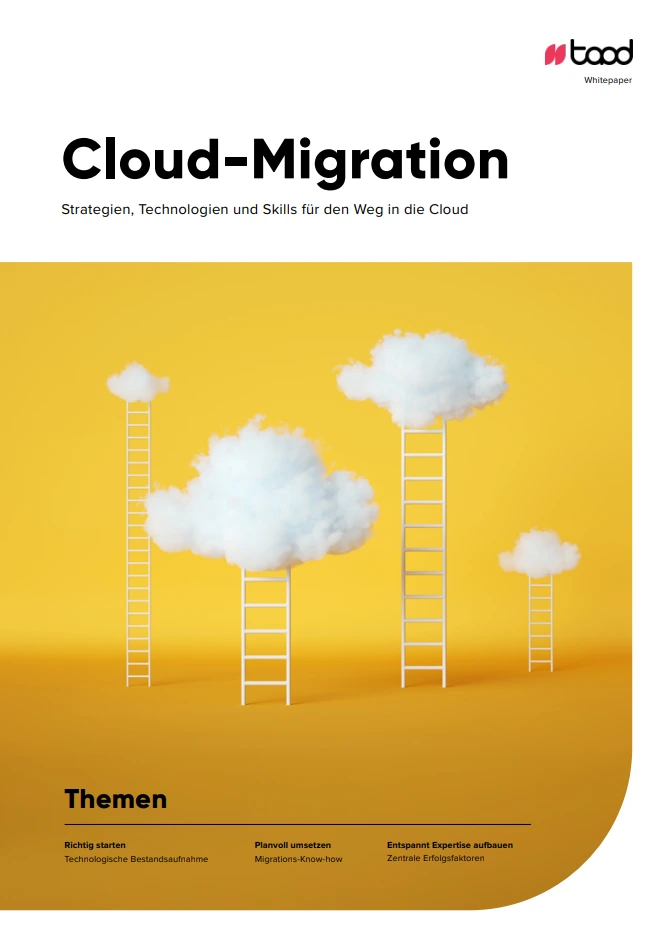
In this white paper, you will learn how to use a well-thought-out cloud strategy, modern cloud services and a sprint-based approach to move to the cloud securely and in a structured way — and thus minimize risks, generate real added value and make your company sustainable for the future.
In this white paper, you will learn how to use a well-thought-out cloud strategy, modern cloud services and a sprint-based approach to move to the cloud securely and in a structured way — and thus minimize risks, generate real added value and make your company sustainable for the future.
Four insights to move your cloud migration forward
Learn which steps you should take when migrating to the cloud.
Inquire now without obligation1. Clarify starting point
How to find the right start to your cloud strategy with Inventory & Readiness Assessment.
2. Choose a migration approach
Sprint-based, modular migration with AI support: for fast results, high quality and low risk.
3. Think about data strategy
“Data as a Product” as a basis for new business models and data-driven processes in the cloud.
4. Plan the future
What counts after the migration: multi-cloud, FinOps, upskilling — and how to ensure long-term flexibility.
We use leading technologies for your cloud migration





Your data experts and white paper authors

Migration is not a marathon, but consists of a series of sprints — an ongoing process in which migrates piece by piece and creates added value in order to achieve the big goal in the long term.
Andreas Schiffer
Senior Data Engineer, taod
Andreas specializes in developing scalable and efficient data solutions. He helps companies fully modernize their data infrastructures and brings experience both in legacy technologies and in the modern data stack such as Snowflake, Databricks, dbt and Power BI. Through his focus on process automation and data-driven decision-making processes — also in the context of generative AI — he enables companies to be more agile and future-proof.
.webp)
The journey to the cloud is no longer a question of whether, but of how. The cloud is the cornerstone for sustainable growth, increased innovative capacity and long-term competitive advantage.
Laurence Kuhlburger
Junior Data Engineer, taod
Laurence specifically supports companies in modernizing their data infrastructures and using new technologies effectively — in particular through her extensive experience with tools such as Databricks. With her STEM background, she explores complex technical relationships precisely and purposefully. Their approach combines deep technical expertise with a clear understanding of the specific requirements, contexts and objectives of users and organizations.

Questions that will help you
FAQ
What is the difference between cloud migration and true cloud transformation?
Cloud migration is not a technical endpoint, but the starting point of a strategic transformation. The mere presence in the cloud does not yet create a competitive advantage — the decisive factor is how cloud architectures and data management principles are used to achieve business goals. taod therefore makes a clear distinction between the technical move and the actual transformation. From more efficient processes to data-based decisions and the development of new business models.
How should cloud migration be structured to minimize risks and achieve measurable ROI early on?
A cloud migration should not be planned as a marathon, but as a series of targeted sprints. In each sprint, a functional unit is transferred to the new environment. Accompanied by automated data reconciliation, data quality reporting and AI-supported expertise. A hybrid rollout, in which old and new solutions are operated in parallel, minimizes failure risks and delivers measurable ROI in early phases.
How can companies avoid vendor lock-in during cloud migration?
Vendor lock-in can be effectively reduced through two measures: multi-cloud strategies and open standards. Those who rely on vendor independence from the outset retain technological flexibility and can react agilely to new market developments. Complemented by FinOps principles, in which engineering, finance and business jointly manage cloud spending, the result is a cost structure that can be planned in the long term.
What is the role of AI in cloud migration?
AI fulfills two functions in the migration process: It accelerates the migration itself, through automatic pattern recognition, variance analysis and automation of central migration steps. And that is the goal: The cloud is the prerequisite for economically viable use of AI, as it provides computing capacity, specialized tools and pre-trained models on-demand. Without the cloud, many AI projects would simply be too expensive or barely feasible.
What do companies need to do before they start cloud migration?
Each migration is preceded by a readiness assessment: a structured inventory of the existing IT landscape, governance structures and team capabilities. On the basis of a maturity model, strengths, weaknesses and the need for action become visible. Only then should measurable goals be defined and migration projects prioritized according to added business value.
Learn more about cloud migration

blog
Controlling costs in the cloud
Learn how to stay in control of your costs with Databricks, Snowflake, and Fabric.
.webp)
Case
Cloud data warehouse at SKF
Case about automated and cloud-based, comprehensive sales controlling.

Service
Cloud Data Platform Consulting
We build an architecture that really suits your business.

Stay up to date with our monthly newsletter. All new white papers, blog articles and information included.
Get exclusive knowledge for your data projects. In our print magazine data! Experienced data experts report directly from the world of data.
Data! subscribe