
The new data order
%20(2).webp)


Governance, integration, and AI are changing the platform landscape
Just a few years ago, everything revolved around performance and price. Today, the focus is on other questions: How much control do we have over our data? How easy is it to integrate AI applications? And how do we avoid data landscapes falling into silos?
The requirements for modern data platforms have fundamentally shifted. Companies no longer just expect a stable foundation for reporting and analysis, but an integrated, controllable and AI-enabled platform architecture. Three players represent this change particularly clearly: Snowflake, Databricks and Microsoft Fabric.
The shift from silos to integrated data platforms
The first cloud era was about storing data faster and cheaper. Today, the focus is on consolidation: Instead of combining many specialized tools, companies want a central, consistent data platform, from integration to evaluation. This one-platform trend brings several benefits: reduced complexity, unified governance, and a consistent view of data across departments. Especially in the context of generative AI, this consistency is becoming increasingly important. Only those who control data can use it for AI in a trustworthy way.
Governance is moving from a control tool to an enabler. It creates trust and transparency and has therefore become a basic requirement for data-driven innovation.
Three key questions for choosing the right data platform
The decision for a data platform is no longer a purely technical act, but a strategic building block for the future viability of a company. If you want to move in the right direction, you should ask yourself three key questions.
1. How much centralization makes sense in a data platform?
Many companies have developed a patchwork of tools, databases and integration solutions over the years. Although this diversity offers flexibility, it often results in frictional losses, additional costs and an architecture that is difficult to control. On the other hand, an overly centralized platform can limit the agility of individual teams. The solution lies in the middle: a modular yet integrated architecture that creates common standards for data management and security without restricting freedom of innovation. Modern platform strategies combine centralized governance with decentralized responsibility and thus enable efficiency and agility at the same time.
2. How does data governance become a strategic competitive advantage?
Governance has long been regarded as an impediment to innovation and a bureaucratic necessity to control risks. But the understanding has changed: Today, governance is the key to scaling. Companies that automatically control data quality, origin, and access rights create a trustworthy foundation on which analytics and AI initiatives can securely build. Governance is thus transformed from a control mechanism to a strategic enabler, because it makes data usable, comprehensible and future-proof.
3. How AI-ready should a modern data platform be?
Artificial intelligence is only as good as the data on which it is based. If you want to use AI productively, you need more than computing power, namely clean, consistent and curated data flows. Platforms that combine data management, processing and analysis in a continuous process create clear advantages here. They make it possible to quickly train models and operationalize results while meeting governance requirements. This creates a data-driven ecosystem that not only allows AI, but actively promotes it.
Three platforms, three approaches: Databricks, Snowflake, and Microsoft Fabric
The answers to these three key questions clearly show how complex and strategic the choice of platform has become today. The focus is no longer solely on storing or analyzing data, but on designing a holistic data ecosystem that integrates governance, integration and AI.
Three providers stand out in particular on the market: Databricks, Snowflake and Microsoft Fabric. They shape the discourse because they share different technical roots but a common vision. All three aim to combine data, processes and intelligence in a single, consistent platform.
Databricks comes from the world of machine learning and open data architectures, Snowflake from the classic cloud data warehouse environment, while Microsoft Fabric is the latest player to consistently integrate the end-to-end concept into the Microsoft ecosystem. Together, they represent the new generation of data-driven platforms that are flexible, scalable and increasingly AI-oriented.
Three vendors are approaching: Databricks is expanding governance capabilities, Snowflake is opening up towards AI, and Fabric is merging integration with automation.
Strengths and differences of leading platforms
Three vendors are approaching: Databricks is expanding governance capabilities, Snowflake is opening up towards AI, and Fabric is merging integration with automation.
Databricks: Focus on AI, Lakehouse, and Open Architecture
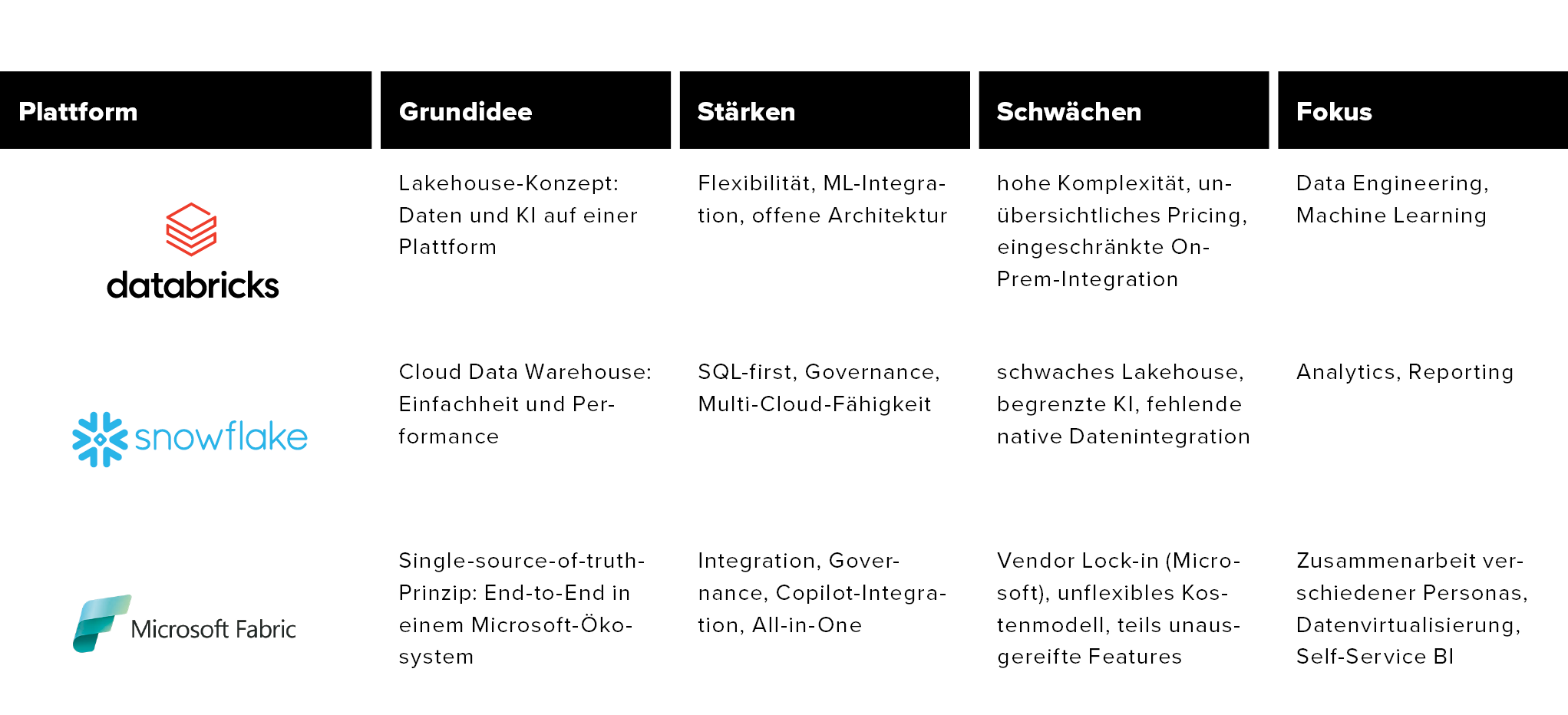
Databricks scores particularly well with the close integration of data and AI workloads. The open lakehouse model based on Delta Lake combines flexibility and governance with powerful scalability. The Unity Catalog ensures strong data governance and lineage. The integration of streaming data in real time enables cutting-edge analyses. Thanks to open source roots (Spark) and open architecture, Databricks benefits from a broad developer community.
Snowflake: Scalability and Ease of Use in the Data Warehouse
Snowflake impresses with its high level of abstraction and simplification of complex processes, which makes the platform particularly accessible and efficient. It offers outstanding elasticity and scalability, supported by an easy-to-implement RBAC model. Another highlight is the integrated data marketplace, through which provided data sets can be used.
Microsoft Fabric: End-to-end platform in the Microsoft ecosystem
Fabric shines as a comprehensive end-to-end platform that enables collaboration between different personas — from developers to analysts to specialist departments — on a common basis (OneLake). The seamless integration of BI and analytics significantly lowers the barrier to entry. Other platforms such as Snowflake, Databricks and data sources from hyperscalers such as AWS, GCP or on-premise can be easily integrated (mirroring, shortcuts, etc.).
Why the interplay of governance and AI is crucial
The future of data platforms will not only be decided by individual features, but also by the interplay of governance, integration and AI readiness. Companies that manage to combine data strategies and AI initiatives on a consistent platform gain a strategic advantage both technologically and organizationally. The next big step will be not only to train AI models on data, but also to integrate them into the operational data flow — automated, comprehensible and compliant.
Today, choosing a data platform is no longer a purely technical decision. It is a strategic paver for governance, innovation and efficiency in equal measure. Anyone who orchestrates data, processes and AI models on a common basis builds the foundation for sustainable business success.
.webp)


.webp)

